
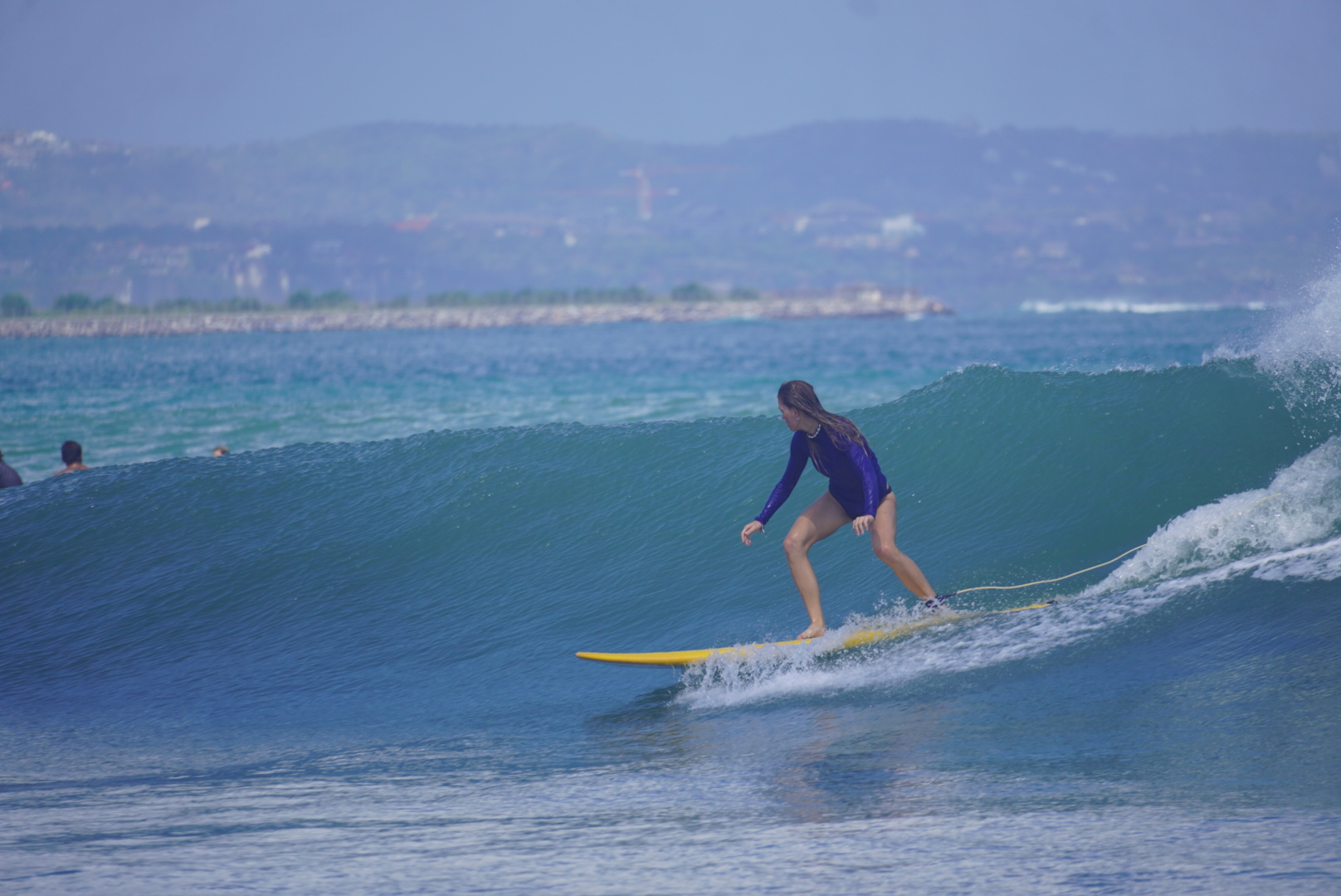
There is a moment in the ocean that every surfer knows. You are sitting in the lineup, the set is taking its time, and the water is doing exactly what it wants. And you just have to wait.
Yoga taught me to sit inside this feeling.
And surfing taught me that everything I practised on the mat eventually shows up in the water.
The wave that made it real
I was surfing in Kuta, Bali, when the fin of my board caught my foot and cut it open. At first, I thought it was a cramp. When I pulled my foot out of the water and saw the wound, panic moved through me fast.
But then, I started breathing. Deep, slow, deliberate. The breath I had practised hundreds of times on a yoga mat. It was not easy. The thoughts came anyway. What if I cannot walk? What if this is serious? But I kept returning to the breath, and the breath kept returning me to what was actually true in that moment: I was okay. I could walk. I was safe. And my only goal right now was to get out of the water.
Later, sitting on the beach waiting for help, a different wave of thoughts arrived. My trip is ruined. I cannot surf for weeks. What will I do for a whole month in Sri Lanka? How much will this cost?
Yoga had taught me something about those thoughts, too. They are not facts. They are just thoughts. And underneath them, if you breathe long enough, there is usually something quieter and more honest, in my case, gratitude. Gratitude that the injury was not worse. Humility that the ocean had reminded me, once again, who is in charge.
That moment on the beach taught me a lot about the connection between surfing and yoga.
What yoga actually does for your surfing
Balance and body awareness
Surfing is a constant conversation between your body and the wave beneath it. The more you understand your own body, where your weight is, how your hips move, where your gaze lands, the better that conversation goes.
What surprised me is how much of that conversation happens in shapes you already know from yoga. Like when you are lying on your board and push up, that is Cobra. Popping up, stepping forward and landing wide, that is Warrior I. And the gaze? We call drishti in yoga= a fixed point that anchors the whole body, is exactly what determines where your board goes. You look left, you go left. You lose your focus, you lose the wave.
Studies have shown that regular yoga practice significantly improves balance, proprioception (your body’s sense of its own position in space), and core stability. All of this is translated directly onto a board. Watch the similarities in the video!
Breath and what it does underwater
Pranayama= yogic breathwork builds real lung capacity and teaches you to regulate your nervous system under pressure.
A regular pranayama practice significantly increases vital lung capacity. For surfers, that is not a small thing.
I noticed its effects gradually. I could stay calm underwater longer. I was less panicked during hold-downs. The breath had become a reflex, not a technique I had to remember.
Flexibility where it counts
Surfing works specific muscle groups hard. Shoulders from paddling, hip flexors from pop-ups, lower back from arching, and ankles from constant micro-adjustments. Without proper flexibility and recovery, these areas tighten and eventually cause injury or limit progression.
When I teach yoga on surf trips, I design sequences specifically around these areas. Hip openers. Shoulder mobility. Spinal lengthening. Ankle stretches. Not generic yoga but yoga that speaks directly to what the water asks of the body.
What surfing does for your yoga
The exchange goes both ways.
Surfing teaches patience in a way that is almost impossible to manufacture on a mat. You cannot force a wave. You can be perfectly positioned, perfectly ready, and still watch the set roll through without giving you anything. You learn to wait without tension. To stay present without grasping.
Surfing also teaches you to overcome fear in a way that is deeply physical. The first time you paddle out into bigger waves, no amount of thinking your way through it will help. You have to breathe, commit, and go. Choosing to go anyway despite the fear is one of the most transferable things surfing gives you. It shows up on the yoga mat when a pose feels too hard. It shows up in life when a decision feels too big. Once you have paddled out scared and made it, you carry that with you.
I tell students the same thing on the mat that the ocean taught me: progression is slow, it is not linear, and ignoring the signals your body sends you is how people get hurt. In yoga as in surfing, patience is not passive. It is a practice.

The pose every surfer needs
If I had to choose one — Warrior III.
It requires genuine balance, a committed gaze, and what I can only describe as inner anchoring. You have to be grounded and dynamic at the same time.
“Soft enough to breathe, strong enough to hold.”
That is exactly what surfing asks of you the moment you stand up on a wave.
The gaze is everything in both. In Warrior III, your eyes fix on a single point, and your whole body organises around that focus. On a wave, the same thing happens: where you look is where you go. Yoga trains this without you even realising it.
They are teaching the same thing
At their core, surfing and yoga are both practices of presence.
Both ask you to show up, pay attention, and stop trying to control what you cannot. Both will humble you regularly and reward you slowly. Both will teach you more about yourself than you expected.
If you surf and have never tried yoga, your body and your mind are waiting for it. And if you practise yoga and have never been in the ocean, there is a version of your practice out there that moves and breathes and pushes back.
Come find it.
Curious about combining surf and yoga in one trip? That is exactly what Waves & Within retreats are built around.
Read more or get in touch.
Leave a Reply